|
| Hungry? |
If a picture is worth a thousand words, hopefully this blog will make up for lost time. I'm going to attempt to create for you the eating experience of China. The adventure begins on the street. Since most restaurants lack the capacity to hold onto raw ingredients for more than a day or so - either due to less-than-hygienic standards for keeping food, or more likely the lack of space in the establishment itself - raw food is delivered daily or purchased in markets. Many times, they give cooks the pleasure of killing your own, so frequently you'll see a chicken on your way to school and come back to find a substantially less living, naked thing in its place.
 |
| Dan Dan Noodles |
 |
| Our regular restaurant |
Very quickly, you find that every dish is prepared differently in different restaurants but you learn what places do what dishes and which way you like them. One such staple is 担担面 known in the states as Dan Dan Noodles. It's a peanut-based dish with plenty of numbing pepper, the source of Sichuan's notorious spice.
 |
| The origin of takeout |
The place above also is good for Gai Fan, which basically means meat and vegetables on rice. There are lots of different varieties of it, but the picture to the right shows my favorite - twice-cooked pork with onion. It also demonstrates takeout at it's simplest: a disposable bowl in a plastic bag. Another big hitter cuisine-wise in this province is what we in America have come to know as Kong Pao Chicken, that delicious chicken with chunks of cucumber, peanuts and (naturally) more numbing pepper. Now while Dan Dan Noodles and Gai Fan are individual dishes, Kong Pao Chicken and most other dishes like it are served "family-style."
 |
| Beef w/ Peppers |
 | |
| Potato Straws; KP Chicken; Onion Beef |
|
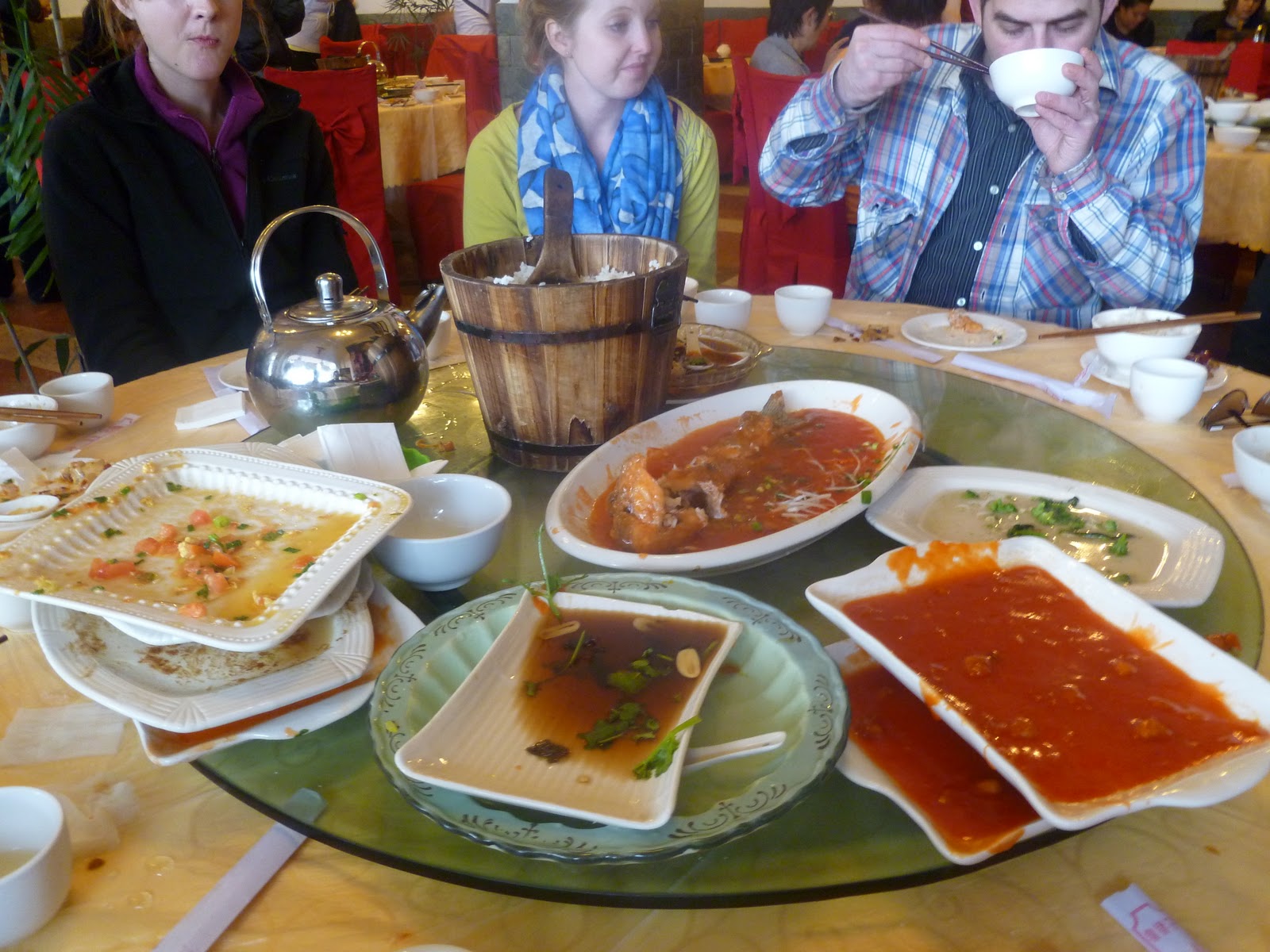
That is to say, everybody grabs some chopsticks and digs in, throwing a few pieces from the main plate into your own bowl. Between the mainly oil-based dishes and all the MSG, it doesn't sound healthy, does it? To give you some more glimpses of what we're eating here are some other dishes.
 |
| Street food |
Now there are more restaurants than we could count and rather than learn each place's name, we elect to refer to them by defining features such as, "The red curtains," or, "The place outside of the west gate," or my personal favorite, "the one with the waiter so-and-so has a crush on." But these restaurants tend to close early and to address this problem, there is street food. Street Food is any and all meals coming from a tricycle stand or cart. These can be miniature fried peanut butter and jelly pancakes, Korean BBQ, dough-based omelets, as well as sweet potatoes or pineapple skewers. To the right is a sort of pork burger with lettuce and egg, delicious and cheap.
Now while I've given particular notice to the meat and the carbs, there are other food groups that need to be represented. Tomato and Egg make the base for many soups and noodle dishes, sometimes served just by itself - not a big hit for me but a popular entre during family-style. China has also introduced me to eggplant in fish sauce, a new favorite vegetable of mine. And while the fish sauce is delicious, you'll notice very few pictures involving fish itself. It isn't a lack of fish in the area, it's that fish come fully boned with tiny strands as difficult to swallow as to pluck out.
 |
| Family-style: a roaring success |
 |
| Eggplant |
 |
| Tomato w/ Egg |
Lastly, I want to introduce you to my new favorite dish, my personal creation, 宫爆鸡蛋炒饭. After much urging, I convinced a restaurant to make Kong Pao Chicken on Egg Fried Rice - a phenomenal mixture, (likely with double the MSG) that despite their initial doubts and weird looks, has brought the restaurant a few extra patrons - both, American and Chinese. In the future, I'll hopefully have more to show you along the lines of food as well as some of the new discoveries that I'm making each meal. Until then, thanks for reading.

 Last Friday our program went to Beichuan, the epicenter of the Earthquake that rocked the Sichuan Province in China, 2008. I was about to type something to the effect of, "It seems like natural disasters are becoming more and more prevalent," when in reality it's probably that we have just become more aware of them in the last couple decades due to the internet. After all, if not for the internet, I wouldn't be typing this now, would I? But all that being said, we have seen some pretty catastrophic natural disasters in the last few years. I'm thinking the earthquake in Haiti, the BP Oil Spill (at least as far as its environmental implications are concerned), the recent earthquake in Japan and I'll go ahead and rehash hurricane Katrina. These aren't in order and their causes aren't all similar but the effects are unanimously negative: economies blown apart, governments shaken, cities crumbled, families displaced and many people dead or wounded. Long story short, nobody's happy.

 So when we were told that we were going to the museum of the ruble that was Beichuan, I couldn't help but wonder if we were treading where we weren't welcome; if people were rolling in their graves as we unwittingly walked on top of them. This was my first experience in the scene that is the aftermath of a natural disaster and was less than inspiring. We got off the bus and for the first time, a group of white people wasn't the thing worth taking pictures of. All over the place were Chinese people staring at the buildings, at the debris. Many of the structures were being supported by multiple, thick, metal beams to keep them from falling upon onlookers. The major sites were dotted with small informative, posts to tell you initial estimates of casualties compared with actual number, as well as a little information regarding what the building was used for, and what it originally looked like.

 The buildings were in varying states of disrepair. All were cracked, some with warped window and door frames. Broken glass everywhere. Some buildings were tilted at angles as if a giant game of dominoes had been put on hold and others had just fallen over completely. We walked on a bridge that took us through the middle of one - to our left we could look at the floor of one story and to our right we could see the ceiling of the next. The path weaved in and out of destruction and the sidewalk had become stair-steps in some places, in light of the event. The major highway that tunneled through a hill to connect Beichuan to ten other cities has since become a waterfall.
  Finally, we got to the housing district. You could see mattresses displaced and a desk knocked over. Markers had collected in one corner of a house where they had rolled to. It's one thing when you see a broken window or a door hanging off its hinges but when you can look into a bathroom and realize someone lived there... that's when it all becomes real.
 Further away was the new city, at a better location. The original city was by many beautiful mountains, likely as a defensible position in earlier years, but the new city is by a river which will help boost it's economy. The buildings there are comparatively well built and are painted in matching color schemes which is something that other cities in China can't stand up to. It has some lawns and young trees - in all reality, it reminds me of a western city. No one can deny that the earthquake was a disaster but it has allowed Beichuan to rebuild, to emerge as a newer and more sophisticated city, at least in appearance. Hopefully other cities won't need such nature-related coercion but if China is smart, they can key in on this silver lining and look into developing their other cities in ways fitting for a developed country.